
Pergola Permit Requirements Melbourne: Your 2026 Building Guide
- Shane Herring
- 2 days ago
- 13 min read
In the eyes of your local council, a "pergola" isn't defined by its style or the quality of its timber, but by whether or not it has a roof. Getting this distinction wrong is the primary reason homeowners find themselves facing fines or orders to tear down a brand-new structure. Understanding the specific pergola permit requirements Melbourne residents must follow in 2026 is the first step toward a successful build.
It's frustrating to feel like you're stuck in a maze of paperwork before you've even picked up a hammer. You just want a solid outdoor space without the stress of council intervention or the fear of hidden costs. This guide will help you navigate those regulations with ease, giving you a clear "yes or no" on whether your project needs official approval. We will look at the 20-square-metre exemption rule, the critical difference between building and planning permits, and how to stay compliant while creating the perfect backyard retreat.
Key Takeaways
Learn why the legal definition of a pergola depends entirely on its roof and how getting this wrong turns your project into a verandah.
Check if your project meets the 20-square-metre limit and other Schedule 3 criteria to bypass the usual pergola permit requirements Melbourne councils enforce.
Understand the difference between building permits for structural safety and planning permits for local overlays to ensure you don't miss a critical approval.
Follow a straightforward five-step process to organise your paperwork, from conducting site surveys to final council lodgement.
Discover why partnering with a licensed carpenter ensures your structure meets the National Construction Code and simplifies the surveyor liaison process.
Table of Contents
What is Legally Considered a Pergola in Melbourne?
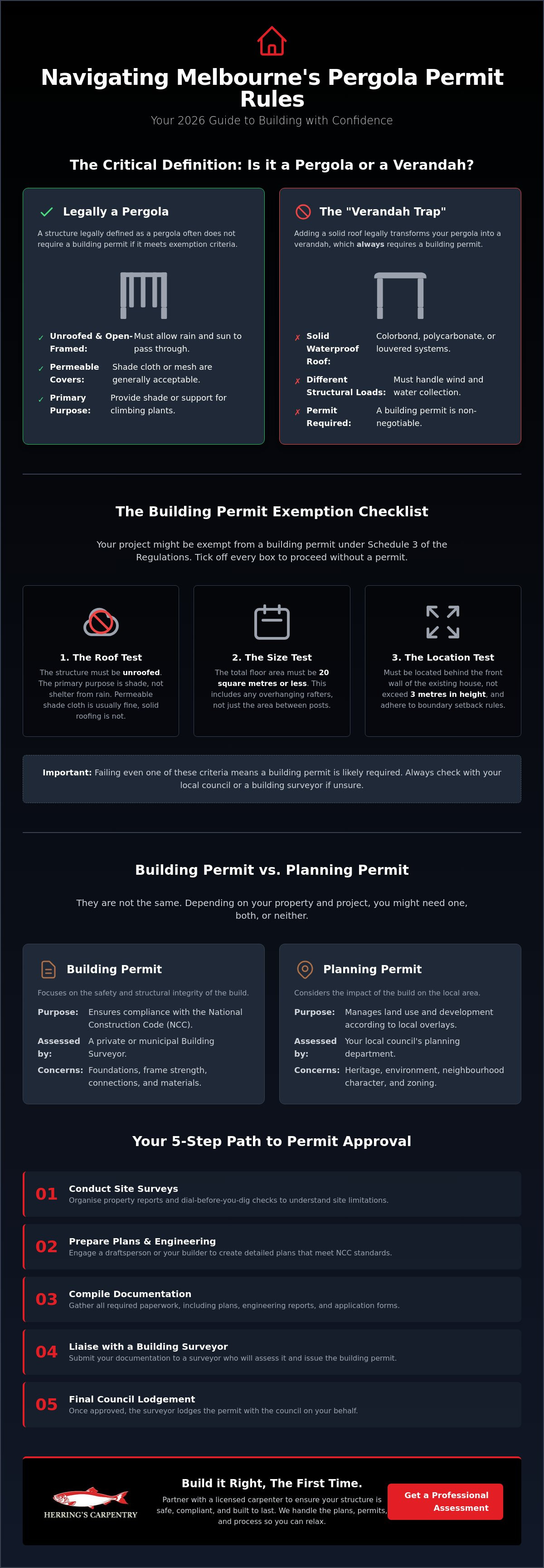
Under Victorian Building Regulations, the term "pergola" has a very specific legal meaning. It isn't just a fancy name for any outdoor timber structure. To be legally classified as a pergola, the build must be unroofed and open-framed. Its primary job is to provide shade or act as a support for climbing plants. If you start enclosing the sides with walls or adding a solid, waterproof covering, you've stepped outside the legal definition. This distinction is the foundation of What is a Pergola? and it's exactly what building surveyors look for when assessing a site. Understanding the specific pergola permit requirements Melbourne residents must follow starts with this basic definition. If it doesn't have a roof, it's a pergola. If it does, you're likely building a verandah.
The "Verandah Trap": When a Pergola Changes Identity
Many homeowners fall into the "Verandah Trap" without realising it. You might start with an open frame, but then decide you want to stay dry during a sudden Melbourne downpour. The moment you fix Colorbond, polycarbonate sheets, or even certain louvered systems to the top, the structure legally transforms into a verandah. This change is significant for your paperwork. Verandahs always require a building permit because they carry completely different structural loads. A solid roof catches wind and collects water, meaning the footings and connections must be much stronger to meet the National Construction Code.
What about "temporary" covers? High-density shade cloth or permeable mesh usually keep the structure within the pergola category because they allow water to pass through. However, if the material is water-proof or solid, the council won't see it as a pergola anymore. Even retractable systems can be a grey area depending on your specific council's interpretation. It's better to get the classification right at the start than to receive a notice from a building inspector later.
Common Materials and Their Permit Implications
Whether you choose treated pine timber battens or a sleek steel frame, the material itself doesn't usually change the permit status. What matters is the "openness" of the design. Building surveyors measure how much of the roof area is actually covered by the rafters and battens. To meet the pergola permit requirements Melbourne residents are looking for, the structure must remain essentially open to the sky.
Attachment also plays a role in how your project is viewed. A free-standing pergola in the middle of your garden is often simpler to clear than one attached to your house. If the structure is bolted to your existing roofline or walls, it becomes part of the main building's structural system. This doesn't automatically trigger a permit requirement, but it does mean the installation must be handled with precision to avoid compromising your home's integrity. Keeping the structure open and unroofed is your best path to a straightforward project.
The 2026 Pergola Building Permit Exemption Checklist
Not every backyard project needs a mountain of paperwork. In Melbourne, many smaller structures fall under what the state calls "Schedule 3" exemptions. This means if your project meets specific criteria, you can skip the building permit process entirely. According to the Victorian Building Authority permit exemptions, a pergola is exempt if it's unroofed, small, and positioned correctly on your block. However, the rules are strict. If you miss even one requirement, you're technically building an illegal structure. Staying on the right side of the law ensures your home insurance remains valid and you avoid those dreaded council "please explain" letters. Understanding these pergola permit requirements Melbourne homeowners face in 2026 is about more than just bureaucracy; it's about building with confidence.
Understanding the 20 Square Metre Rule
The most common threshold for an exemption is the size of the structure. Your pergola must have a floor area of 20 square metres or less. It's a common mistake to only measure the distance between the posts. Council inspectors look at the total footprint of the structure, including any overhanging rafters. If you're planning to build a series of smaller structures, be careful. Councils often view multiple structures on the same property as a cumulative total. If your new pergola plus an existing shed exceeds the allowable limit for unpermitted works, you might find yourself in hot water. Precision matters here. Inspectors aren't interested in "near enough" when they have a tape measure in hand. If you're unsure about your measurements, consulting a builder for a professional timber pergola layout can save you a massive headache later.
Height and Boundary Restrictions
Height is the next big hurdle. To remain exempt, your pergola must be no more than 3.6 metres tall. This measurement is taken from the "natural ground level" directly beneath the structure. This gets tricky if your yard is sloped. You can't just measure from the highest point of the dirt. If you're building your pergola on top of an existing deck, remember that the 3.6-metre limit still applies from the ground, not from the deck boards.
Location on your property is equally important. For most Melbourne residential zones, the structure must be located behind the front wall of your house. If you want to build in the front yard, you're almost certainly going to need a permit, regardless of the size. You also need to keep a close eye on easements. Even a small, unroofed pergola cannot be built over a sewerage or drainage easement without specific consent from the relevant water authority. It's a simple rule: if it's over a pipe, you need to ask first.
Planning Permits vs. Building Permits: What is the Difference?
One of the biggest sources of confusion for homeowners is the difference between a building permit and a planning permit. A building permit is all about the nuts and bolts. It ensures your structure is safe, stable, and compliant with the National Construction Code. It's the document that confirms your footings are deep enough and your timber spans are correct. A planning permit, however, focuses on the big picture; it looks at how your structure impacts the neighbourhood, the environment, and the local aesthetic. While you might meet the size exemptions listed in the Victorian Building Authority pergola permit rules, those rules only apply to building permits. You could still be legally required to obtain planning approval before you start. Failing to check for local overlays is the most common reason for legal delays and unexpected fines in Melbourne.
You might need one, both, or neither. It depends entirely on your specific property and which council area you fall into. This is why understanding the full scope of pergola permit requirements Melbourne councils enforce is vital. Getting a building permit doesn't mean you have planning permission, and vice versa. They are two separate hurdles to clear.
Melbourne Overlays: Heritage, Bushfire, and Flooding
If you own a Victorian-era cottage in Carlton or Fitzroy, you're likely living under a Heritage Overlay. In these areas, the council wants to make sure your new timber structure doesn't clash with the historical aesthetic of the street. You might be restricted on the types of materials you use or even the colour of the timber stain.
Other common triggers include the Bushfire Management Overlay (BMO) and Land Subject to Inundation Overlays (LSIO). If you're in a high-risk bushfire zone, your pergola might need to be built with specific fire-resistant timbers or non-combustible materials like steel. In flood-prone areas, the council will want to ensure your structure won't obstruct the flow of water during a heavy storm. Ignoring these overlays is a recipe for disaster.
Zoning and Your Local Council
Zoning also plays a huge role in your project. Building in a Residential Growth Zone usually offers more flexibility than in a Neighbourhood Residential Zone. Every council has its own set of local laws. A project that sails through in the City of Monash might be knocked back or require extra paperwork in the City of Boroondara.
Before you even pick up a pencil to draw a plan, get a current Copy of Title. This document is essential. It lists any restrictive covenants or easements that could kill your project before it starts. Some older titles in Melbourne have "single dwelling" covenants or specific rules about where you can build outbuildings. It's a simple document to obtain, but it provides the clarity you need to move forward without looking over your shoulder.
How to Organise Your Pergola Permit in 5 Steps
Once you've determined that your project doesn't fall under the exemptions discussed earlier, it's time to get the paperwork moving. Organising your permit shouldn't be a headache if you follow a logical path. The pergola permit requirements Melbourne councils demand are there to ensure every structure is safe for the long haul. Following a structured process keeps the project on track and avoids costly mid-build corrections.
Step 1: Conduct a site survey. Check your property's title for easements and use services like Dial Before You Dig to locate underground pipes or cables.
Step 2: Draft professional plans. You need more than a rough sketch. Your drawings must show elevations, the exact location on the block, and how the structure connects to the ground or existing house.
Step 3: Appoint a Registered Building Surveyor (RBS). In Victoria, you can choose a private surveyor or a municipal one. They are the ones who will ultimately issue your permit.
Step 4: Pay government levies. Once the surveyor is satisfied, you'll need to pay the required state building levies before the official Permit to Build is issued.
Step 5: Schedule mandatory inspections. Your surveyor must check the footings before the concrete is poured and conduct a final inspection once the timber work is complete.
The Role of the Building Surveyor
A Registered Building Surveyor acts as an independent auditor of your project. They don't just "ask the council" for permission; they evaluate your structural drawings against the National Construction Code. They look at timber spans, bolt sizes, and wind ratings to ensure the structure won't become a hazard. When the job is done, they issue a Certificate of Final Inspection. It's different from an Occupancy Permit, which is reserved for habitable rooms like extensions or new homes. For a backyard structure, the Certificate of Final Inspection is your proof of a legal build. If you want a project that sails through this process, working with experienced pergola builders who understand these technical details is the smartest move you can make.
Common Mistakes That Delay Approval
The most frequent delay comes from incomplete drawings. If your plans don't clearly show the relationship between the new pergola and the existing house, the surveyor will send them back. Stormwater is another common sticking point. Even for an unroofed pergola, some councils require you to demonstrate how water run-off from the timber frame will be managed so it doesn't flood a neighbour's property. Finally, never attempt to build over an easement without written consent from the relevant Water Authority. Without that "Report and Consent" document, your building permit application will be rejected immediately. Taking the time to get these details right at the start is the only way to avoid a bureaucratic nightmare.
Why a Licensed Carpenter is Your Best Bet for Permit Success
Building a structure that lasts requires more than just a hammer and a few lengths of timber. It requires a deep understanding of the National Construction Code (NCC) and the specific ways Melbourne weather impacts structural integrity. Licensed carpenters like Shane Herring don't just build to look good; they build to meet the rigorous safety standards that building surveyors demand. When you engage a professional, you aren't just paying for labour. You're paying for someone to handle the drafting and the constant back-and-forth with surveyors on your behalf. This ensures your deck and pergola packages Melbourne are fully compliant from the very first day of the build.
The real value of professional help often shows up years later. When the time comes to sell your home, the buyer's solicitor will look for a Certificate of Final Inspection for any outdoor structures. If you can't produce that document, it can stall a sale or forced you to lower your price. Having a licensed professional manage the pergola permit requirements Melbourne councils enforce gives you that essential paper trail. It's the ultimate insurance for your property's value.
The Risks of the "DIY Kit" Approach
It's tempting to pick up an off-the-shelf pergola kit from a big-box retailer, but these products often come with hidden risks. Many generic kits are designed for a broad market and don't account for specific Melbourne wind-loading requirements. A structure that's perfectly fine in a sheltered Sydney suburb might not stand up to a gusty afternoon in the Dandenongs or along the coast. If a kit structure fails or if a neighbour reports an unpermitted build, you'll likely receive an "illegal works" notice. The cost of rectifying these issues, or worse, tearing the structure down, far outweighs the initial savings of a DIY approach. Professional carpentry ensures the build matches the approved plans exactly, leaving no room for council disputes.
Getting it Right the First Time with Herrings Carpentry
Shane Herring brings over 30 years of hands-on experience to every project. We've spent decades navigating the quirks of Melbourne council requirements, from the inner-city heritage zones to the sprawling outer suburbs. Our approach is grounded in no-nonsense advice. We won't sugarcoat the process; if your project needs a permit, we'll tell you straight and explain exactly why. We take pride in our workmanship and our reputation for honesty. We believe the process should be as reliable as the finished structure itself. Ready to build? Contact Herrings Carpentry for an honest quote today and let's get your project started the right way.
Start Your Build on Solid Ground
Understanding the pergola permit requirements Melbourne homeowners must follow is the difference between a relaxing backyard retreat and a stressful legal headache. You now know that the absence of a roof is what keeps your structure legally classified as a pergola; and that staying under the 20-square-metre limit is your best chance for a permit exemption. However, local overlays and specific site conditions mean there's rarely a one-size-fits-all answer. Navigating these rules requires a clear head and a bit of local expertise.
Getting it right the first time requires a blend of technical knowledge and practical experience. As a fully licensed and insured Registered Building Practitioner with over 30 years of local Melbourne carpentry experience, Shane Herring specialises in creating custom, council-compliant outdoor structures that stand the test of time. We take the guesswork out of the paperwork so you can focus on enjoying your new space without looking over your shoulder.
Book a consultation with Shane Herring to discuss your Melbourne pergola project. We'll give you a straight answer on what your block requires and help you build an outdoor area that adds genuine value to your home. Let's get your project moving today.
Frequently Asked Questions
Do I need a permit for a pergola that is not attached to the house?
Attachment doesn't determine whether you need a permit; size and roofing are the deciding factors. Whether your structure is free-standing or bolted to the house, the same Schedule 3 criteria apply. If the structure is unroofed, under 20 square metres in area, and no more than 3.6 metres high, you generally don't need a building permit. Always double-check your property title for easements before you start digging footings in the middle of your yard.
What is the penalty for building a pergola without a permit in Melbourne?
Building without a permit can lead to substantial fines from your local council and legal orders to demolish the structure at your own expense. Beyond the immediate costs, unpermitted work often surfaces during property inspections when you try to sell your home. This can stall a contract or force a significant price reduction to cover the risk for the buyer. It's much cheaper to get the paperwork right at the start than to pay for a retrospective approval later.
Does a new deck always require a separate building permit from the pergola?
Most decks in Melbourne require a building permit regardless of whether they have a pergola on top. While a small, unroofed pergola might be exempt, the deck beneath it usually needs approval if it's more than 800mm above ground level or close to a boundary. It's best to lodge a single application covering both structures. This approach saves on surveyor fees and ensures the entire project meets the National Construction Code requirements.
How long does it typically take to get a pergola permit approved in Victoria?
You can typically expect a building permit to be issued within two to four weeks once your professional drawings are submitted to a building surveyor. However, if your project also requires a planning permit due to a heritage or bushfire overlay, the process can take several months. Starting your planning early is the best way to avoid delays. Getting your pergola permit requirements Melbourne paperwork sorted well before summer ensures you're ready to build when the weather clears.
Can I apply for a permit after the pergola is already built?
You can't technically apply for a permit after the work is finished; instead, you must apply for a Building Information Certificate or a stay of proceedings from the council. This process is often more expensive and stressful than getting a permit beforehand. A surveyor will need to inspect the footings and structural connections, which might involve uncovering parts of the finished build. It's a gamble that rarely pays off and can lead to forced demolition.
Do I need my neighbours’ permission to build a pergola on the boundary?
You don't usually need a neighbour's formal permission, but you must comply with "Protection Work Notices" if your build could affect their property. If you're building right on the boundary, there are strict rules regarding height and length to protect their light and privacy. It's always a good idea to have a chat with them over the fence first. Keeping the peace locally often prevents unnecessary complaints to the council building department.
Is a planning permit required if I live in a heritage area?
Living in a heritage-protected area almost certainly means you'll need a planning permit, even for a small pergola. The council wants to ensure the materials and scale of your new structure don't detract from the historical character of the neighbourhood. Meeting the pergola permit requirements Melbourne councils set for heritage zones often requires specific timber finishes or traditional design elements. Size exemptions for building permits don't override these local planning overlays.
What happens if my pergola is over 20 square metres?
If your structure exceeds 20 square metres in floor area, a building permit is mandatory under Victorian law. This size limit is a hard cap; even being slightly over will trigger the need for a full structural assessment by a building surveyor. This ensures that larger structures are properly engineered to handle wind loads and stay stable for decades. It's a standard safety measure that protects your property value and ensures the structure is built to professional standards.


Comments