
External Cladding Melbourne: The Homeowner’s Guide to Materials and Installation
Choosing the wrong facade for a Melbourne home isn't just a cosmetic mistake; it's a gamble with your property's structural integrity against some of the most unpredictable weather in Australia. It's understandable if you're feeling overwhelmed by the choices. Most homeowners we talk to want the timeless appeal of natural timber but worry about relentless maintenance, or they're confused by the 2026 updates to Victorian building regulations. You need a solution that looks sharp, meets strict BAL ratings, and actually lasts.
This guide is designed to help you find the best external cladding Melbourne has available, drawing on 30 years of hands-on carpentry expertise to simplify your decision. We'll show you how to achieve a weather-resistant finish that boosts your curb appeal without breaking your budget. We'll explore the performance of local hardwoods versus modern composites, explain the transition to the new Building and Plumbing Commission (BPC), and provide a clear path to a home exterior you can trust for decades. Whether you're planning a renovation or a new build, getting the details right starts with honest advice and a master craftsman's perspective.
Key Takeaways
Understand how the right facade acts as a critical weather barrier against Melbourne's volatile climate and "four seasons in one day."
Compare the natural beauty of Australian hardwoods like Spotted Gum with the low-maintenance durability of modern composite materials.
Learn the reality of long-term upkeep so you can choose a material that fits your lifestyle, whether that's regular oiling or a simple annual wash-down.
Navigate the 2026 Victorian building regulations and BAL ratings to ensure your home remains compliant and safe in high-risk areas.
Discover why professional installation is the only way to guarantee your external cladding Melbourne project is structurally sound and built to last.
Table of Contents
What is External Cladding and Why Does Your Melbourne Home Need It?
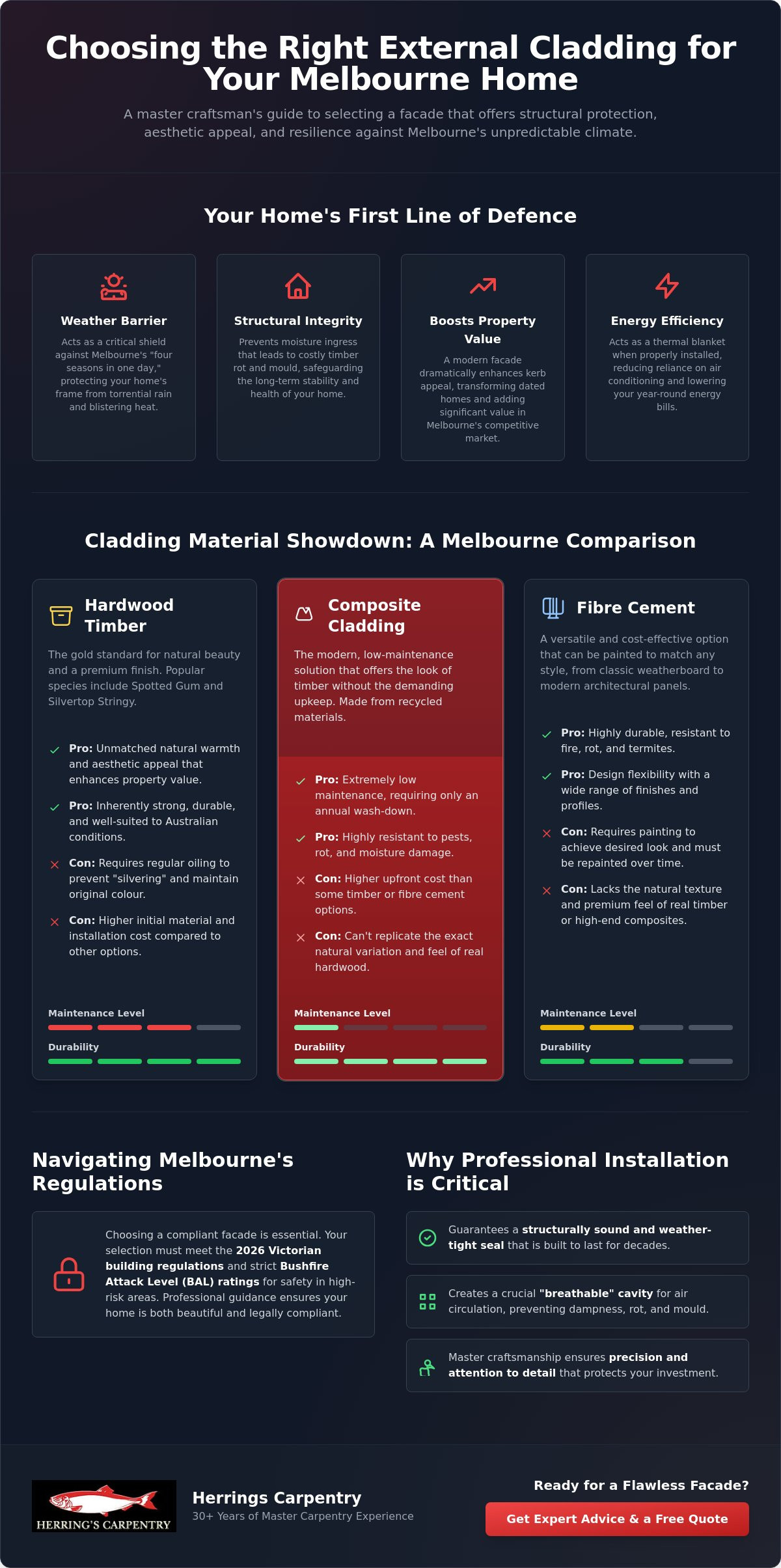
In its simplest form, What is External Cladding refers to the protective outer skin fixed to your home's structural frame. It isn't just a decorative choice; it's a functional layer designed to shed water and protect the building from the elements. For homeowners considering external cladding Melbourne projects, it's the first line of defence against a climate famous for swinging from blistering heat to torrential rain in a single afternoon. Without a high-quality facade, your home's timber framing is vulnerable to moisture ingress, which leads to costly rot and structural instability. We see many older properties where the original barrier has failed, causing problems that could have been avoided with a more durable material choice.
Modern cladding does more than just shield the structure. It acts as a primary barrier that improves your home's overall efficiency. When we strip back old, failing materials, we often find that the house hasn't been breathing correctly. Proper installation ensures that your home remains a comfortable sanctuary, regardless of the outdoor temperature. It's the most effective way to give a house a fresh start, providing both a structural upgrade and a visual transformation that lasts for decades.
The Aesthetic Impact on Property Value
A well-chosen facade can completely change the personality of a house. We often see 1970s brick veneer homes that look tired and dated. By installing modern timber or composite features, you can modernise the entire property without the expense of a full rebuild. This isn't just about looks. There is a strong link between high-quality timber detailing and successful Melbourne auction results. Buyers in suburbs from Glen Waverley to Eltham value the warmth and premium feel that natural textures provide. Choosing a style that respects your suburb's character, whether it's a sleek architectural finish or a classic weatherboard look, ensures your investment adds genuine market value. It's about making your home stand out in the street for all the right reasons.
Structural Protection and Insulation
Beyond the visual appeal, the right external cladding Melbourne installation acts as a thermal blanket. When combined with modern sarking and high-performance insulation, it keeps your home significantly cooler during a January heatwave. This reduces the load on your air conditioning and lowers your energy bills year-round. A critical part of our process involves creating a "breathable" cavity. This gap between the cladding and the wall wrap allows moisture to escape and air to circulate. It prevents the dampness that often plagues older Victorian homes. By ensuring a weather-tight seal, we protect the internal framing from the rot and mould that can compromise your family's health and the building's longevity. It's a technical job that requires precision to get right.
Comparing Popular Cladding Materials: Timber, Composite, and Fibre Cement
Selecting the right material for your external cladding Melbourne project depends on your lifestyle and your suburb's specific climate. A home in the Dandenongs faces different environmental challenges than a property in Brighton. You have to weigh up the initial cost against the long-term maintenance you're willing to handle. We've seen every type of material installed across the city, and each has its place depending on the look you want and the time you have for upkeep.
Hardwood Cladding: The Traditional Choice
Australian hardwoods are the gold standard for natural beauty. Species such as Spotted Gum and Silvertop Stringy provide a premium finish that's difficult to replicate with man-made products. Silvertop Stringy and Blackbutt are especially popular for Melbourne's coastal and bush properties due to their inherent strength and durability. You should understand the natural ageing process before committing. Without regular treatment, timber will "silver" over time. While this weathered look is a deliberate design choice for some, others prefer the rich, original honey tones. For those tracking their budget, we've put together a timber cladding cost guide that covers 2026 pricing and installation details.
The Rise of Low-Maintenance Composites
Many homeowners are moving toward low-maintenance composites. These products use a mix of recycled wood fibres and plastics, offering a sustainable choice that handles the Victorian sun without fading or warping. They don't require the regular oiling or staining that natural timber demands to stay looking new. This makes them ideal for upper-storey sections where maintenance access is a genuine headache. You get a consistent look that stays sharp for years without needing to get up on a ladder every eighteen months. It's a practical solution for busy families who want the aesthetic of wood without the chores.
Fibre Cement and Modern Metal Finishes
Fibre cement, such as the James Hardie range, is another heavy hitter in the Melbourne market. It's highly durable, fire-resistant, and comes in various profiles to suit different architectural styles, from traditional weatherboards to modern vertical grooves. It's a reliable "set and forget" option for many. For a more contemporary architectural look, aluminium and metal cladding offer a sleek, virtually maintenance-free finish. These materials work exceptionally well for feature walls or full facades on modern builds. If you're looking to update your home, our team provides renovation support and fit-outs to help you choose the best fit for your specific structure and budget.
The Maintenance Debate: How Much Work is Really Involved?
One of the first questions we get asked about external cladding Melbourne projects is how much work it takes to keep the house looking good. There is a lot of talk about "maintenance-free" materials, but honestly, every exterior surface needs some level of care. Melbourne's weather is tough on buildings. Wind-driven rain and intense UV exposure mean that even the toughest products require a bit of attention to ensure they reach their full lifespan. Choosing a material is about deciding how much time or money you want to invest in upkeep over the next twenty years.
The biggest mistake homeowners make is believing the "set and forget" myth. We recommend a quick walk-around after any major Melbourne storm. You should look for debris trapped in the drainage gaps or any signs of movement in the boards. It isn't just about the boards themselves; it's about the system. When we install cladding, we focus on preventing water from getting trapped behind the facade. Professional installation ensures that flashings and sealants are doing their job, which is the only real way to prevent the rot that ruins so many older homes in our suburbs.
Oiling vs. Weathering Timber
If you choose natural timber, you're signing up for a regular oiling schedule. A north-facing wall that catches the full force of the summer sun will likely need oiling every 12 to 18 months to keep its original colour. South-facing walls that stay in the shade might last twice as long. We always suggest using a high-quality Australian oil specifically formulated for our local UV levels. If you decide to let your timber go grey, that's fine, but you still need to ensure the wood is sealed to prevent moisture from soaking in. If you change your mind later, a greyed-out wall can be restored with a chemical clean and a light sand, though it's a labour-intensive process.
Long-Term Durability of Modern Materials
Fibre cement and modern composites are the heavy lifters when it comes to durability. While a hardwood facade can last 40 years with perfect maintenance, fibre cement offers similar longevity with far less effort. Usually, a simple wash-down with a garden hose once a year is enough to remove salt spray or dust. You should still keep an eye on the sealants at the joins and around window frames. These are the "soft points" where moisture ingress usually starts. By using high-grade flashings and ensuring a clear drainage cavity during the initial build, we help extend the life of your external cladding Melbourne investment and protect the framing underneath from expensive, hidden damage.
Choosing Cladding for the Melbourne Climate and Regulations
Melbourne's climate is notoriously hard on building materials. We often see facades that look great in a showroom but fail when faced with our city's sudden temperature drops and high humidity. For an external cladding Melbourne project to succeed, the chosen material must have a low rate of thermal expansion. If a product expands and contracts too aggressively between a 38-degree afternoon and a 12-degree evening, you'll eventually see buckling boards or failed sealants. It isn't just about picking a colour; it's about selecting a system that can move with the weather without losing its weather-tight seal.
Navigating the legal side of a facade change is just as critical as the installation itself. As of May 2026, the Building and Plumbing Commission (BPC) has taken over as the primary regulator in Victoria. They enforce strict rules regarding combustible materials, particularly the prohibition of certain aluminium composite panels and expanded polystyrene products in specific construction types. Local expertise is vital here. We understand how to work within these 2026 regulations and can help you manage the council permit process to ensure your renovation is fully compliant and insured. If you're planning a project that involves structural changes, we provide framing for extensions and new builds to ensure your home's skeleton is as solid as its new skin.
Bushfire Compliance (BAL Ratings)
A Bushfire Attack Level (BAL) rating is a scale used to determine the potential for a building to be exposed to ember attack, radiant heat, and direct flame contact. For homeowners in the Dandenongs, the Yarra Ranges, or the outer northern fringes, this rating dictates exactly what you can put on your walls. Certain Australian hardwoods like Spotted Gum and Blackbutt are naturally fire-resistant and are often approved for use in lower BAL-rated zones. However, in high-risk areas, you may be required to use non-combustible fibre cement or specific metal systems to meet insurance requirements. Getting this wrong doesn't just risk your safety; it can make your home impossible to insure.
Weather-Proofing for the "Four Seasons"
Cheap cladding often fails during a heavy Melbourne downpour because the installer didn't account for a proper drainage plane. Water will eventually find its way behind any facade. The secret to a long-lasting home is ensuring that moisture has a clear path to exit through the bottom of the wall via a ventilated cavity. Without this, dampness gets trapped against your timber frame, leading to rot that you won't see until it's a major structural problem. We focus on high-quality flashings and precise gap spacing to allow for natural expansion. This methodical approach ensures your home handles the "four seasons in one day" without a single leak or warped board.
Why Professional Installation by Herrings Carpentry Makes the Difference
A quality external cladding Melbourne project is only as good as the hands that install it. You can buy the most expensive Australian hardwood or the highest-rated composite boards, but if they aren't fixed with precision, they will eventually fail. With over 30 years of local carpentry experience, Shane Herring has seen the results of shortcuts and "slap-it-on" methods. We take a different approach. We focus on the technical details that most people never see, ensuring your home's new facade is as structurally sound as it is beautiful. It's about doing the job right the first time so you don't have to worry about it for the next three decades.
Our process begins with a thorough check of your existing wall framing. We don't just cover up old problems. If your home's skeleton has rot, moisture issues, or is simply out of plumb, we fix those foundational issues before the first cladding board is ever levelled. This attention to detail is what prevents future buckling and ensures a perfectly flat, professional finish. We believe in honesty and straightforward communication. If your frame needs work, we'll tell you plainly and explain why it matters for the longevity of your investment.
Precision around windows and doors is where most DIY and low-cost cladding jobs fall short. These are the critical points where leaks usually begin. We use high-grade flashings and meticulous sealing techniques to create a weather-tight barrier that handles the worst of the Victorian rain. Our no-nonsense approach to project management means we handle everything from the initial quote to the final clean-up, leaving your property tidy and your home protected.
The Master Carpenter’s Eye
Achieving a high-end architectural look requires more than just basic tools. Techniques like "secret fixing," where nails or screws are hidden within the profile of the board, require a steady hand and a deep understanding of material expansion. We take pride in our mitred corners, ensuring every join is tight and seamless. This level of craft is what separates a standard renovation from a master-built home. When you work with a licensed and insured Melbourne carpenter, you get the peace of mind that comes from knowing your property is in professional hands. We organise every stage of the build, from the moment materials are delivered to the final inspection, so the process is as stress-free as possible for you.
Integrated Outdoor Solutions
Many of our clients want to refresh their entire property at once. We can easily tie your new facade into a custom deck or pergola package, creating a consistent aesthetic across your whole outdoor living space. This creates a seamless flow between your indoor renovation and your outdoor entertaining areas, significantly boosting your home's curb appeal and functional value. Whether you need a feature wall to match a new deck or a full home wrap, we provide the same level of care and accountability to every project. Contact Herrings Carpentry today for an honest assessment of your home’s exterior and a clear path to a better-looking, more durable property.
Secure the Future of Your Home’s Facade
Investing in external cladding Melbourne is one of the most effective ways to protect your property and boost its value. The key is to match your choice of material to your lifestyle and the specific demands of the Victorian climate. Whether you opt for the premium look of natural hardwood or the durability of fibre cement, remember that the quality of the installation determines the life of the build. Getting the drainage, flashings, and regulatory compliance right from the start prevents expensive repairs down the track.
Shane Herring is a Licensed Victorian Building Practitioner with over 30 years of experience in the trade. As specialists in high-end timber finishes, we pride ourselves on a no-nonsense approach that puts the integrity of your home first. We'll help you navigate the latest building codes and BAL ratings with honest, straightforward advice. If you're ready to upgrade your home with a facade that's built to withstand the elements, we're here to help you get the job done right.
Book a Consultation with Shane Herring for Your Melbourne Cladding Project
Frequently Asked Questions
Do I need a permit for external cladding in Melbourne?
Yes, most external cladding Melbourne projects that involve a change in the building's appearance or material require a building permit. This ensures the work complies with the latest Victorian fire safety standards and structural regulations. Minor repairs to existing boards usually don't need a permit, but a full reclad of your home almost certainly will.
Can I install new cladding directly over my old brick walls?
You can install new facade materials over brickwork by using a method called "battening out." We fix timber or metal battens to the brick first to create a level surface and a ventilated cavity. This air gap is essential because it prevents moisture from being trapped against the old wall. We always check that your existing footings are stable enough to support the extra weight before we start.
What is the most durable cladding for a coastal Melbourne home?
Fibre cement and high-density Australian hardwoods like Spotted Gum are the most reliable choices for coastal properties. These materials resist the corrosive effects of salt spray and handle high wind loads without warping. While some metal products can struggle in seaside environments, fibre cement provides a stable, long-lasting finish that requires very little maintenance near the ocean.
How much does professional cladding installation cost per square metre?
The price of installation depends on several variables, including the material choice, site access, and whether we need to install scaffolding. A multi-storey home or a project that requires stripping back old, damaged materials will naturally involve more labour. We provide honest, fixed quotes after a site inspection so you have a clear understanding of the investment required for your specific home.
Is timber cladding a fire risk for my property?
Timber is safe to use as long as it matches your property's Bushfire Attack Level (BAL) rating. Certain local species are naturally fire-resistant and are approved for use in many Victorian suburbs. If you live in a high-risk area, we'll guide you toward materials that meet the strict non-combustible requirements of the 2026 building regulations to ensure your home is safe and insurable.
What is the difference between weatherboards and cladding?
Weatherboards are a specific style of external cladding Melbourne homeowners have used for generations, typically featuring long boards that overlap horizontally. Cladding is a broader term that covers any material used to skin the outside of a building. This includes modern vertical boards, large architectural panels, and even metal systems. Essentially, all weatherboards are cladding, but not all cladding is weatherboard.
How often should I re-oil my timber cladding in Victoria?
You'll generally need to re-oil north-facing timber walls every 12 to 18 months to protect them from intense UV exposure. Walls that stay in the shade for most of the day can often last two or three years before they need a fresh coat. Regular maintenance prevents the wood from drying out and cracking, which keeps the structural integrity of the boards intact for decades.
Can cladding improve the energy efficiency of my home?
Installing new cladding is an excellent way to improve your home's thermal performance and reduce energy bills. When we reclad a house, we install modern sarking and high-quality insulation behind the boards. This creates a more consistent indoor temperature, keeping you cooler in the peak of summer and warmer during Melbourne's cold winter nights without overworking your air conditioner.


Comments