
Best External Cladding Materials Melbourne: A Homeowner’s Selection Guide
- Shane Herring
- 2 days ago
- 12 min read
If you think your home's exterior is just a cosmetic choice, you haven't lived through a Melbourne winter followed by a 40-degree north-nor'westerly. Selecting the best external cladding materials Melbourne has to offer is actually about choosing the primary line of defence for your home's structure. It is the difference between a house that ages gracefully and one that succumbs to rot and moisture build-up within a few short seasons.
We understand the frustration of maintaining old, peeling weatherboards and the genuine headache that comes with deciphering current BAL ratings and the latest Building and Plumbing Commission regulations. You want a modern, weather-tight finish that adds value to your property without requiring a paintbrush in your hand every second weekend. This guide discovers the most durable cladding options for our erratic climate and explains how to achieve a long-lasting facade.
You will learn which materials stand up to the local elements, from fire-resistant fibre cement to premium Australian hardwoods like Spotted Gum. We also explain why even the most expensive material will fail without the precision of a master carpenter to install it correctly. Let's look at how to choose a facade that protects your investment for the long haul.
Table of Contents
Choosing External Cladding in Melbourne: More Than Just a Facade
Top Cladding Materials: From Hardwood to Modern Fibre Cement
Durability and Fire Safety: Navigating Melbournes BAL Ratings
The Carpenters Edge: Why Professional Installation Trumps a DIY Job
Maximising Property Value with Custom Timber Features and Cladding
Choosing External Cladding in Melbourne: More Than Just a Facade
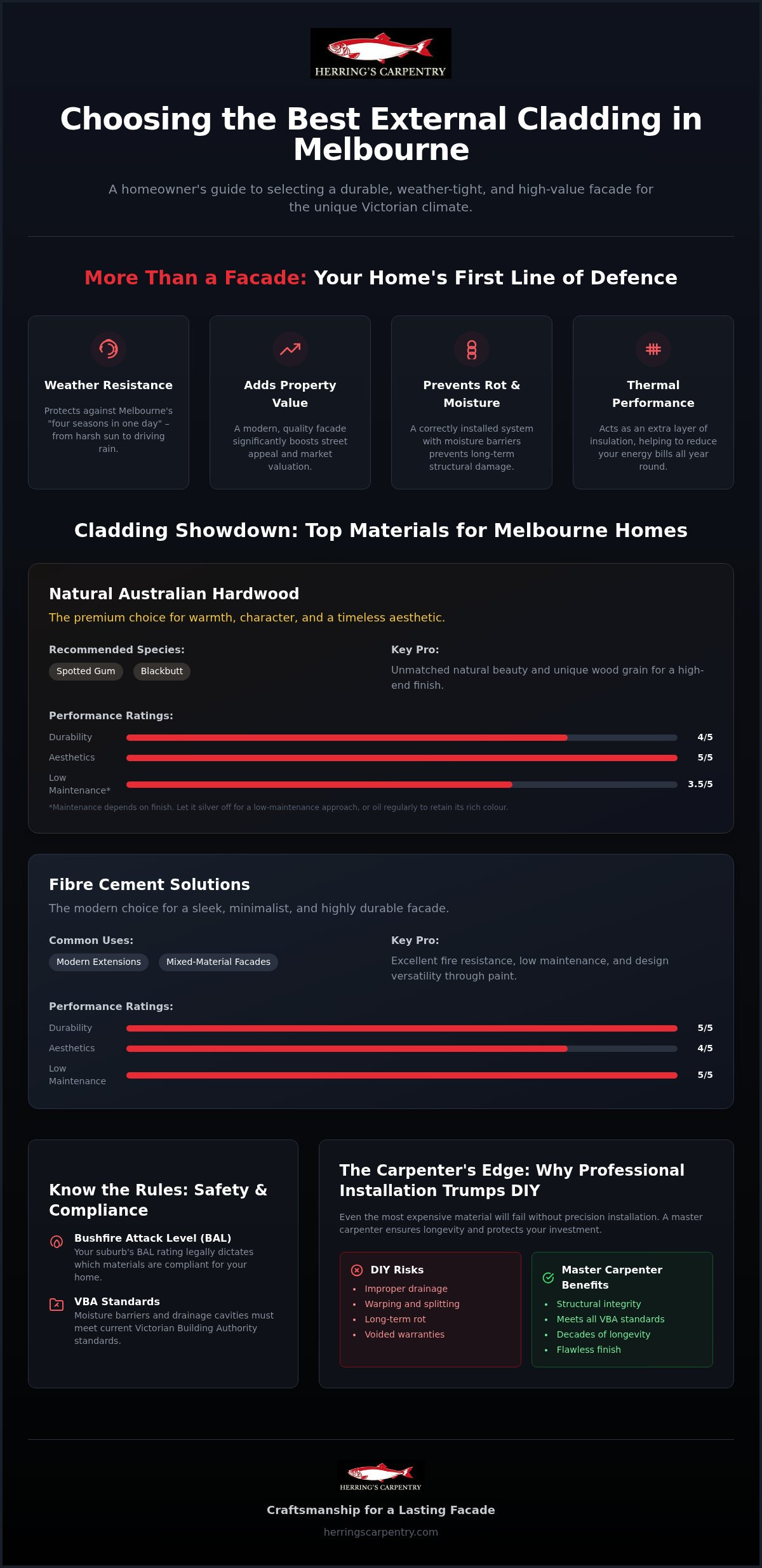
In the building trade, we view Cladding (construction) as the critical skin of a home. It is a protective envelope that does far more than just look good on a real estate brochure. For a house in Victoria, this layer is the first line of defence against a climate that famously delivers four seasons in a single afternoon. Without the right choice, your home's structural framing is left vulnerable to the elements.
Finding the best external cladding materials Melbourne homeowners can rely on isn't just about picking a colour from a catalogue. It involves understanding how different textures and densities react to our local humidity and temperature swings. At Herrings Carpentry, we take a master carpenter's approach to every facade. We don't just nail boards to a wall; we ensure the substrate is plumb and the moisture barriers meet current Victorian Building Authority (VBA) standards so the finish lasts for decades. A quality installation doesn't just protect your home; it significantly boosts street appeal and long-term property value.
The Role of Cladding in Home Protection
Quality cladding acts as an extra layer of insulation. It helps keep your living spaces warm during a bleak July and cool when a January heatwave hits. This thermal performance is essential for reducing energy bills. Moisture management is another hurdle in Victoria. Our wet-dry cycles put immense pressure on building materials, making proper vapour-permeable membranes and drainage cavities a necessity rather than an option. Beyond weatherproofing, the right material density provides acoustic benefits, helping to dull the sound of suburban traffic or the local tram line.
Melbourne Building Styles and Cladding Trends
We see a lot of homeowners in inner suburbs like Richmond or Brunswick looking to modernise traditional Victorian weatherboard homes. The trend is moving away from high-maintenance softwoods toward durable hardwoods or sleek fibre cement. In Bayside and the Eastern Suburbs, mixed-material facades are becoming the standard. This often involves pairing natural timber features with charcoal metal or stone to create a layered, contemporary look. For the eco-conscious, sustainable choices like recycled timber or locally sourced hardwoods are popular because they offer a low carbon footprint and a timeless Australian aesthetic.
Top Cladding Materials: From Hardwood to Modern Fibre Cement
Choosing the right material for your facade is a balance between your budget, your appetite for maintenance, and the specific look you want to achieve. In our experience, most homeowners end up comparing three main categories: natural timber, fibre cement, and composite. Each has its place in the Melbourne market. Selecting the best external cladding materials Melbourne has available means looking past the initial price tag and considering the long-term performance of the product. You want a material that handles our temperature swings without buckling or fading.
Natural Timber Cladding: The Premium Choice
There is a warmth and character in real wood that synthetic materials struggle to replicate. We often recommend Spotted Gum or Blackbutt for Victorian projects. These are dense, durable hardwoods that handle our humidity shifts better than softer pines. You have two paths with timber: you can oil it regularly to keep that rich, honey-toned colour, or you can let it silver off naturally for a weathered, coastal look. Both are valid, but the silvering path is much easier on your weekend schedule. Integrating your new facade with other outdoor elements like decking and pergolas creates a cohesive, high-end look for your home.
Real timber does require a bit of respect for the material's natural movement. It expands and contracts. A master carpenter knows how to allow for this movement during installation so the boards don't cup or split. It is about getting the fixings and the spacing exactly right the first time.
Engineered and Fibre Cement Solutions
If you want a sleek, minimalist look for a modern extension, fibre cement is often the way to go. These panels are incredibly stable and won't warp or rot like poorly maintained wood. They are also a top choice for fire safety. When considering your options, it is vital to check the Building Code of Australia (BCA) requirements to ensure your chosen panels are compliant and non-combustible. This is especially important in high-density inner suburbs or bushy fringe areas where regulations are strict.
Fibre cement is generally faster to install than traditional timber weatherboards. The large sheet sizes mean we can cover ground quickly, which helps keep labour costs manageable. For those searching for the best external cladding materials Melbourne can offer without the ongoing oiling, composite cladding is the modern middle ground. It uses a mix of wood fibres and resins to provide a set and forget facade. It doesn't have the same unique grain as a piece of raw Spotted Gum, but for many busy families, the zero-maintenance trade-off is worth it.
Durability and Fire Safety: Navigating Melbournes BAL Ratings
If you are building in a leafy suburb like Warrandyte, your material options are strictly controlled compared to a project in Richmond. This is due to the Bushfire Attack Level (BAL) rating system used by Victorian councils. It is a measure of a building's potential exposure to ember attack, radiant heat, and direct flame contact. We don't just look at what looks good; we start by checking the map to see what is legally required for your specific block.
Choosing the best external cladding materials Melbourne has on offer means finding the sweet spot where safety meets aesthetics. You shouldn't have to settle for a house that looks like a tin shed just because you live in a fire-prone area. There are plenty of compliant ways to get a high-end finish while following the safety standards promoted by Cladding Safety Victoria and local building codes.
Durability isn't just about fire, though. Termite resistance is a non-negotiable factor for any Melbourne carpentry project. We always recommend timber species or composite products that are naturally resistant or treated to withstand pests. Then there is the weatherproofing. The breather wrap is the most important layer you will never see. It acts as a one-way valve; it lets internal moisture escape while blocking external rain from hitting your timber frame.
Meeting BAL Requirements with Style
For zones rated BAL-12.5 or BAL-19, you can still use certain fire-rated hardwoods like Spotted Gum or Blackbutt. These species have a natural density that makes them resistant to fire. If you are in a higher-risk area, we shift focus to non-combustible options like fibre cement or specific metal systems. At Herrings Carpentry, we ensure every project is fully compliant with Victorian building codes. We take the guesswork out of the paperwork so you know your home is safe and legal.
Protecting Against the Victorian Elements
The harsh Australian sun can bleach a facade in a few years if it isn't protected. We use high-quality UV-resistant finishes to maintain the material's integrity. We also employ rain-screen principles. This involves creating a small cavity behind the cladding to allow air to circulate. This simple step prevents moisture from being trapped against the frame. It is the best way to stop the rot often found in older Melbourne homes.
Correctly installed flashing is the only thing standing between a dry wall cavity and a structural rot disaster.
The Carpenters Edge: Why Professional Installation Trumps a DIY Job
You can purchase the best external cladding materials Melbourne has on offer, but they are only as good as the hands that install them. Cladding is a structural system. It requires far more than just a hammer and a weekend of free time. If the underlying frame isn't right, your expensive new boards will eventually warp, leak, or look amateurish. We've spent decades fixing DIY projects where the homeowner realised too late that walls are rarely as straight as they look.
A professional installation follows a methodical process that prioritises the "bones" of the building. We start by ensuring the substrate is plumb. In many older Melbourne renovations, we have to pack out or plane back existing studs to create a perfectly flat surface. Without this step, your facade will have visible waves. Next, we install high-quality moisture barriers and custom flashings. These are the components that actually keep your house dry. Finally, we move to the precision set-out. We use laser levels to ensure every line is perfectly horizontal across the entire building, including around windows and doors.
The fixing technique also matters. Depending on the material and the desired look, we choose between concealed fixing for a sleek finish or high-grade stainless steel face-fixing for a more traditional aesthetic. Getting the best external cladding materials Melbourne suppliers provide to stay in place for 30 years requires understanding how different fixings react to timber movement.
Correcting Old Structures for New Cladding
Old homes in suburbs like Hawthorn or Camberwell often have wonky frames due to decades of ground movement. You can't just nail new boards over the top and hope for the best. We assess the structural integrity of the framing before the first board goes on. This often involves reinforcing sections of the wall or correcting out-of-plumb corners. If you are in the early stages of a renovation, reading about how to work with a master carpenter Melbourne can help you plan for these structural realities.
Finishing Details That Make the Difference
The difference between a tradesman's finish and a DIY job is found in the corners and reveals. We offer various treatments, from traditional mitred corners to modern external cover strips. Window and door reveals are another critical area. These need to be watertight and stylishly integrated into the facade. Our no-nonsense approach focuses on clean lines and hidden fixings that protect the home while looking sharp. We don't believe in shortcuts because we know the Melbourne weather will eventually find them.
If you want your renovation done right the first time, our team can help with your cladding and feature wall installation to ensure a weather-tight, professional finish.
Maximising Property Value with Custom Timber Features and Cladding
A well-executed facade renovation is one of the most effective ways to boost your home's market value. It isn't just about protection; it's about making a statement from the kerb. When you invest in the best external cladding materials Melbourne has to offer, you're creating a durable, high-end aesthetic that resonates with buyers. We often use cladding to create stunning outdoor feature walls that break up large expanses of render or brick, adding texture and warmth to an otherwise flat exterior.
The real secret to a high-value renovation is integration. We don't just look at the walls in isolation. Our team specialises in creating a unified look by tying your facade into broader outdoor living areas. This often involves our deck and pergola packages in Melbourne, where the timber species and oil finishes are matched perfectly across every structure. This level of detail is what separates a standard renovation from a master-crafted home. Shane Herring's eye for design ensures that every junction and transition is intentional, creating a seamless flow from the front gate to the back fence.
Cohesive Outdoor Design
Achieving a seamless flow requires a bit of planning. We recommend matching your cladding species, such as Spotted Gum or Blackbutt, with your decking boards to create a wrap-around effect. If you're working with a smaller courtyard or a narrow side-access, using vertical cladding is a smart trick to create the illusion of height and space. For a deeper look at how specific timbers perform over time, you can check our external cladding Melbourne guide. These small design choices, backed by the best external cladding materials Melbourne suppliers provide, ensure your home stands out for the right reasons.
The Herrings Carpentry Process
We believe in a no-nonsense, transparent approach to building. Our process starts with an honest consultation where we look at your existing structure and discuss what's actually possible. We provide reliable timelines so you aren't left living in a construction zone longer than necessary. From the first structural check to the final coat of protective oil, we handle the lot. Shane's 30+ years of local experience means he's seen every type of Melbourne home and knows how to ensure your new facade adds long-term value. We're more interested in the integrity of the final product than flashy marketing. If you're ready to plan your renovation with a local expert who values honesty and high standards, let's get the job done right the first time.
Build a Facade That Stands the Test of Time
Choosing the best external cladding materials Melbourne has available is only half the battle. You need a material that meets your local BAL requirements and a carpenter who understands how to manage moisture and structural movement. A facade that looks great on day one should still be weather-tight and solid twenty years later. We've seen too many DIY jobs fail because the basic principles of flashing and drainage were overlooked during the initial set-out.
At Herrings Carpentry, we don't just nail boards to a frame. We bring 30 plus years of master carpentry experience to every project, specialising in the custom timber finishes and structural framing required for high-end extensions and facade renovations. As a family-owned and operated local business, we take a personal interest in the integrity of your home. We're here to ensure your investment adds genuine value to your property through quality workmanship and honest, straightforward advice.
Ready to move forward with a professional who values high standards? Get a no-nonsense quote from Shane at Herrings Carpentry today and let's discuss how to get your renovation done right the first time. Your home deserves a finish that is as reliable as the structure beneath it.
Frequently Asked Questions
What is the most durable external cladding for Melbourne weather?
Fibre cement is often considered the best external cladding materials Melbourne builders use for sheer durability because it is immune to rot and termites. However, Australian hardwoods like Spotted Gum are also incredibly resilient if they are maintained correctly. The real secret to durability isn't just the board itself; it's the quality of the moisture barriers and the precision of the installation beneath the surface.
Do I need a building permit for cladding my house in Victoria?
You generally need a building permit in Victoria if you are changing the material of your external walls or if the work is part of a structural extension. While minor like-for-like repairs might be classed as maintenance, a full re-clad affects the building's fire safety and structural integrity. It's best to check with a registered building surveyor to ensure your project complies with local regulations.
How much maintenance does timber cladding actually require?
Natural timber typically needs a fresh coat of protective oil every 12 to 18 months to keep its rich colour and prevent the boards from drying out. If you prefer the weathered, silver look, the maintenance is much lower, though you should still inspect the boards annually for any signs of movement. For those who want a set and forget facade, fibre cement or composite options are the better choice.
Can I install new cladding over my existing weatherboards?
We don't recommend installing new cladding over old boards. This shortcut traps moisture between the layers, which leads to rot in your structural framing, and it adds significant weight that your existing studs weren't designed to carry. Stripping the walls back to the studs allows us to install modern vapour-permeable sarking and ensure the new facade is perfectly plumb and weather-tight.
What is a BAL rating and why does it matter for my cladding choice?
A Bushfire Attack Level (BAL) rating measures the potential for a building to be exposed to ember attack and radiant heat. It is a mandatory safety standard in many parts of Victoria and directly limits which materials you can legally use. Before you fall in love with a specific timber, you must check your property's BAL rating to see if that species is compliant for your zone.
How long does it take for a professional carpenter to clad a standard extension?
A professional team can usually complete the cladding for a standard single-storey extension in about one to two weeks. This timeframe includes the essential preparation work, such as installing the breather wrap, battens, and custom flashings around windows and doors. Complex designs or multi-storey projects will naturally take longer to ensure every line is level and every joint is sealed correctly.
Is composite cladding better than natural timber for Melbourne homes?
Composite cladding is a better option if you want the look of wood without the ongoing oiling and maintenance. It's incredibly stable and won't warp in the sun. However, natural timber is still the premium choice for homeowners who want the unique grain and character that synthetic products can't replicate. Both perform well in the Melbourne climate if they are installed with a proper drainage cavity.
What is the best way to prevent moisture build-up behind my cladding?
The most effective method is to use a "rain-screen" installation, which involves fixing the cladding to vertical battens to create a small air gap. This gap, combined with a high-quality vapour-permeable membrane, allows the building to breathe. It ensures that any condensation can evaporate and prevents moisture from being trapped against your timber frame, which is the primary cause of structural rot.


Comments