
Merbau Decking Melbourne: The Expert Guide to a Long-Lasting Hardwood Deck
- Shane Herring
- Jun 14
- 12 min read
Updated: Jun 18
A Merbau deck that looks stunning today is easy enough to build, but one that still looks brand new in fifteen years requires more than just a few screws and a tin of oil. When looking for the best merbau decking Melbourne has to offer, most homeowners are drawn to that rich, deep colour. However, they're often held back by the fear of tannin stains ruining their expensive tiles or the boards warping under our harsh Victorian sun. It's a valid concern, especially when you're investing in a backyard space meant for decades of family barbecues.
You're on the right track choosing this timber. It's naturally bushfire-resistant and can easily last 20 years if handled with professional foresight and the right structural subframe. In this guide, we'll explain why the choice between 90mm and 140mm boards matters for your specific layout. You'll learn the truth about managing tannin bleed and the building permit rules you need to follow to keep your project above board. We're here to give you a clear, no-nonsense plan for a deck that adds genuine value to your home without the maintenance headaches.
Key Takeaways
Find out why Merbau is a Class 1 durability hardwood that naturally resists termites and rot, even in Melbourne's unpredictable weather.
Decide between 90mm and 140mm board widths based on how they change the visual scale and modern feel of your outdoor space.
Get practical advice on managing tannin bleed to protect your concrete and tiles from staining during the first few rains.
Learn why the quality of your merbau decking Melbourne installation depends entirely on the structural integrity of the subframe hidden beneath the boards.
See how three decades of local carpentry experience ensures your new deck is built to last 20 years or more.
Table of Contents
Why Merbau Decking is Melbourne’s Most Popular Hardwood Choice
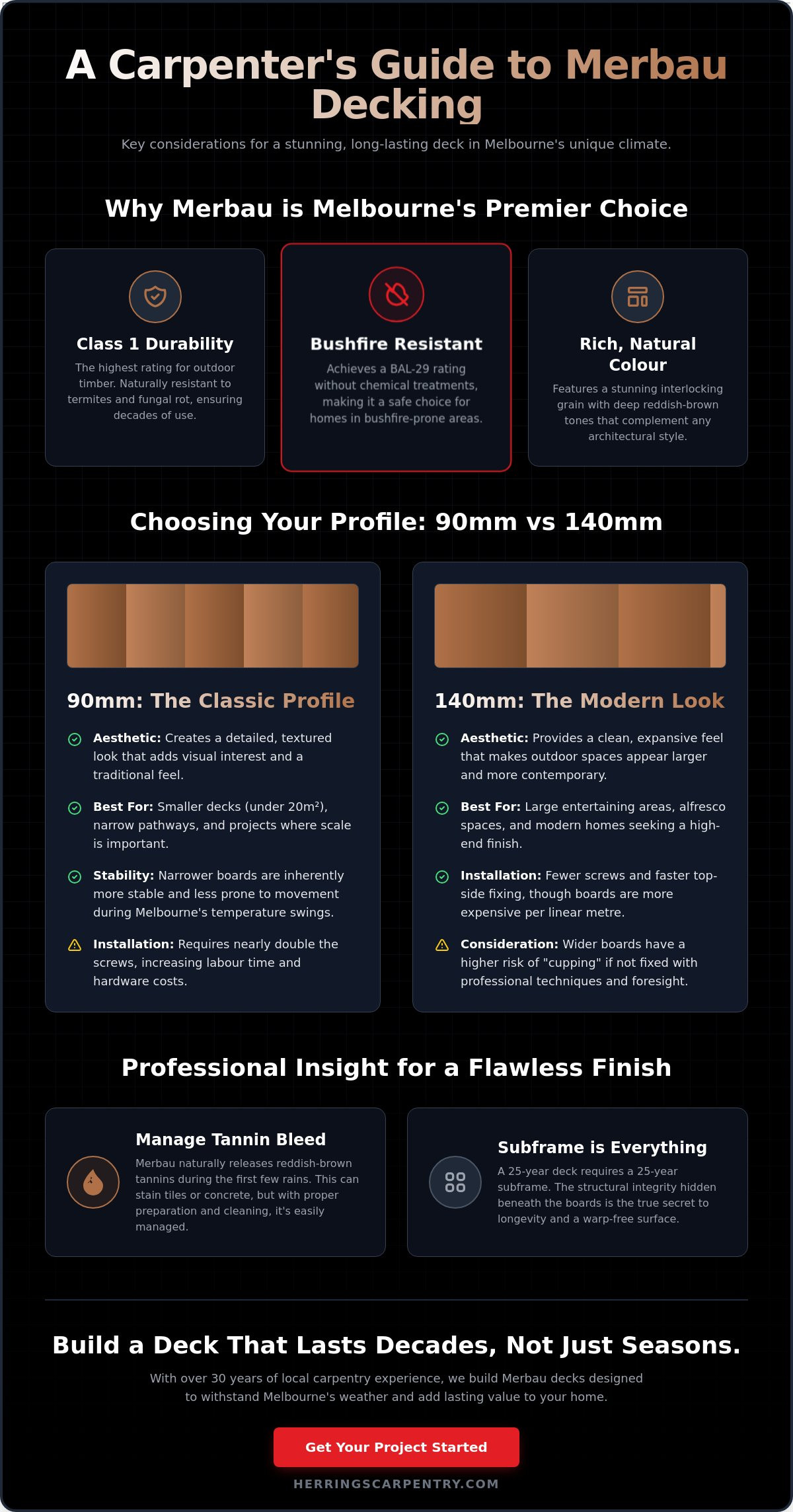
Merbau isn't just another timber option; it's the benchmark for Victorian backyards. When we talk about merbau decking Melbourne homeowners almost always picture that distinct, rich reddish-brown finish that holds its own against our unpredictable weather. This timber is sourced from the Merbau tree species (Intsia bijuga), a slow-growing tropical hardwood that carries a Class 1 durability rating. That's the highest rating available for timber used in ground-contact or outdoor structures. It's tough as nails and built for the long haul.
The secret to its longevity lies in the natural oils and resins found deep within the grain. These substances act as a biological shield, making the wood naturally resistant to termite attacks and fungal rot. You don't need to worry about the wood crumbling or becoming spongy after a few wet winters. It's a dense, heavy material that feels solid underfoot. This is why it's the go-to choice for everything from high-traffic entertaining areas to sleek pool surrounds and custom pergolas.
Durability and BAL Ratings for Victorian Homes
For many of my clients in Melbourne’s outer suburbs, fire safety is a non-negotiable part of the build. Merbau is one of the few timber species that is naturally fire-resistant. It often achieves a Bushfire Attack Level (BAL) rating of BAL-29 without requiring any extra chemical fire retardants. When installing merbau decking Melbourne residents often prioritise this safety feature, especially in bushfire-prone areas where other timbers simply wouldn't meet the building code. When you compare this to cheaper alternatives like Treated Pine, the value is clear. A pine deck might start to warp or rot within a decade, but a well-maintained Merbau deck will easily last 25 years or more.
The Aesthetic Advantage of Tropical Hardwood
Beyond the technical specs, the visual appeal is what really seals the deal. Genuine Merbau features a beautiful interlocking grain pattern and unique "gold flecks" of mineral deposits that catch the light. It's a versatile look that complements the local architecture perfectly. Consider these aesthetic benefits:
Rich Colour: It starts with a vibrant orange-brown hue that deepens into a sophisticated dark red as it ages.
Architecture Match: It looks just as good against a modern rendered wall as it does next to a traditional weatherboard home.
Finish Options: You can apply a high-quality oil to maintain that deep red glow or leave it untreated to silver off into a weathered, rustic grey over time.
This flexibility allows you to tailor the finish to suit your home's specific style. Whether you want a polished, high-end look for an alfresco area or a more natural feel for a garden boardwalk, Merbau delivers every time. It's a reliable performer that adds genuine value to your property.
Choosing the Right Profile: 90mm vs 140mm Merbau Boards
Choosing the right board width is one of the most important decisions you'll make for your outdoor space. In the world of merbau decking Melbourne, you generally have two main choices: the traditional 90mm board or the wider 140mm profile. Both are usually 19mm thick. While it might seem like a purely aesthetic choice, the width of your boards impacts everything from the installation time to how the timber behaves in the sun. Understanding the properties of Merbau timber helps here; it's a stable wood, but wider boards always carry a higher risk of cupping if they aren't fixed correctly.
Wider boards create a cleaner, more expansive look that makes a space feel larger. They also require fewer screws and less drilling, which can speed up the top-side installation. However, the boards themselves are more expensive per linear metre. On the flip side, 90mm boards need nearly double the amount of stainless steel screws. This adds to the material cost and the labour time spent on the tools. It's a trade-off between material price and the time it takes to get the job finished.
The Classic 90mm Profile
The 90mm board is the traditional look for a reason. It provides a more detailed, textured surface that works exceptionally well on smaller decks or narrow side-pathways. Because the boards are narrower, they tend to be more stable during Melbourne's wild temperature swings. If your deck is under 20 square metres, the 90mm profile often feels more to scale with the surroundings. It's a reliable, sturdy choice that has been the backbone of Victorian backyards for decades.
The Modern 140mm Wide Board
For a high-end merbau decking Melbourne project, the 140mm board is often the first choice for homeowners wanting that luxury feel. It mimics the look of wide-plank indoor flooring, helping to blur the lines between your living room and the backyard. It's a premium aesthetic that feels modern and high-end. However, these boards need a bit more muscle. We use heavy-duty fixings to ensure they stay flat, as wider timber has more leverage to pull against the joists when it dries out in the heat.
As a rule of thumb, use 140mm for large, open-plan entertaining zones and 90mm for smaller, intimate spaces or around pool edges. If you're still stuck on which profile suits your home, a quick chat with an experienced deck builder can clear things up. We can look at your plans and tell you exactly how each size will perform on your specific site.
Managing Merbau Tannin Bleed in Melbourne’s Climate
Tannin bleed is the single biggest worry for my clients when they first install merbau decking Melbourne wide. If you aren't familiar with the term, tannins are the natural organic compounds found in the wood's cells. When the timber gets wet for the first time, these tannins dissolve and "bleed" out as a dark, tea-coloured liquid. It's a messy process if you aren't prepared for it, but it's also a sign that you've bought high-quality timber with plenty of protective natural oils. The trick is managing this process so it doesn't leave a permanent mark on your property.
Melbourne's weather doesn't make things easy. Our sporadic rain patterns often mean we get just enough moisture to pull the tannins to the surface, but not enough to wash them away completely. This can leave sticky, dark patches on the boards that look unsightly. To get the best result, I recommend a controlled leaching process. You can either let the deck weather naturally for several weeks of heavy rain, or you can speed up the process by hosing the deck down daily for about two weeks. This "seasoning" period is vital because it opens up the grain and ensures your final oil or stain actually sticks to the timber rather than sitting on top of the tannins.
Protecting Your Concrete and Tiles
If your deck is built over light-coloured pavers, tiles, or new concrete, you must take precautions. Tannin stains are stubborn. I always advise masking off sensitive areas with heavy-duty plastic sheeting and duct tape for the first 6 to 8 weeks. If you do spot a stain on your driveway, a specialized tannin remover or a solution containing oxalic acid will usually lift it, provided you act quickly. Tannin bleed is a natural, temporary process that proves the timber’s high oil content and superior durability.
Sealing and Oiling for the Victorian Sun
Once the timber is seasoned and the bleeding has stopped, it's time to seal it. The UV index in a Melbourne summer is brutal on natural wood. You need a high-quality coating that includes UV blockers to prevent the boards from turning grey too quickly. While traditional oil-based finishes provide a classic look and deep penetration, modern water-based coatings are often better at resisting the sun and staying flexible as the timber expands and contracts. For merbau decking Melbourne homeowners should plan for a maintenance coat every 12 to 18 months. Keeping up with this schedule ensures the wood stays nourished and the colour remains rich and vibrant for decades.
Structural Integrity: Subframes and Fixing Methods
A beautiful surface is only half the battle. When installing merbau decking Melbourne homeowners need to remember that the timber is only as strong as the frame it sits on. Merbau is a heavy, dense hardwood. It puts a lot of stress on the carpentry underneath, so your subframe has to be built with precision. Most Victorian decks use H3 or H4 Treated Pine for the joists and bearers because it's cost-effective and handles the damp ground well. However, if you're building a high-end entertaining area, you might consider a hardwood or even a steel subframe for maximum rigidity. Regardless of the material, joist spacing is critical. For standard 19mm Merbau boards, we set joists at 450mm centres. Any wider and you'll feel a bounce in the deck that makes the whole structure feel flimsy.
Fixing methods also change the look and the life of your deck. You have two main choices: traditional top-down screwing or hidden fastening systems. Hidden fasteners give a clean, nail-free look, but they can be tricky to repair if a board ever needs replacing down the track. Most of our clients prefer the reliability of top-down screws. When done with a steady hand, those straight lines of stainless steel actually add to the handcrafted feel of the project. It shows that the carpenter took the time to measure every single point perfectly.
The Importance of Proper Ventilation
For merbau decking Melbourne projects that sit close to the ground, we pay extra attention to the gap between the soil and the timber. Low-to-ground decks are common, but they're also the most likely to rot if you don't plan for airflow. Without at least 300mm of clearance or proper cross-flow ventilation, moisture gets trapped under the boards. This leads to cupping and subframe failure long before the Merbau itself wears out. We use joist protection tape to keep water from sitting on top of the pine, adding years to the life of the structure. If you're worried about a tight space, get a professional assessment of your site's drainage before you start digging posts.
Fixing Hardware: Stainless Steel vs. Galvanised
Don't let anyone talk you into using galvanised screws for Merbau. The high tannin content we discussed earlier reacts with galvanised metal, causing ugly black streaks around every screw hole. You need 304-grade or 316-grade stainless steel. Pre-drilling and countersinking are non-negotiable steps. Merbau is so dense that driving a screw in without a pilot hole will either snap the head off the screw or split the end of your expensive board. It takes longer to do it right, but the result is a flush, professional finish that won't catch your toes when you're walking around barefoot.
Why Choose Herrings Carpentry for Your Merbau Project
Building a deck is a significant investment. You want to know the person on the tools cares as much about the result as you do. With over 30 years of experience building merbau decking Melbourne wide, Shane Herring has seen every site challenge the Victorian landscape can throw at a project. We don't believe in "cookie-cutter" kits or rushing through a job just to get to the next one. Every home is different. Every deck we build is a custom piece of carpentry designed to fit your specific backyard and lifestyle.
Our approach is simple. We provide honest, no-nonsense communication from the first phone call. You won't get a flashy sales pitch or a quote full of hidden extras. We tell you exactly what's required to build a deck that lasts 20 years, even if that means being upfront about site drainage or structural needs that others might overlook. Being a licensed and insured professional carpenter isn't just about a piece of paper; it’s about giving you the peace of mind that your home is in safe, capable hands.
The Herrings Process: From Design to First BBQ
We handle the heavy lifting so you don't have to. This includes the often-confusing process of organising council building permits, which are generally required for any structural deck in Victoria. We manage the project timeline strictly to ensure your build stays on track. If you're looking for a complete outdoor transformation, we offer deck and pergola packages Melbourne residents can rely on for a seamless, integrated look. Once the last screw is in and the site is cleaned, often leaving it tidier than when we arrived, your only job is to fire up the barbecue.
Local Expertise Across Melbourne
Melbourne's geology varies wildly from the clay-heavy soils of the western suburbs to the sandier patches in the south-east. This matters for your deck’s footings. We understand the specific depth and concrete requirements needed to ensure your merbau decking Melbourne installation remains level and stable for decades. We have built hundreds of decks across the city that still look and feel as solid as the day they were finished. If you're ready for a straightforward, honest assessment of what’s possible in your outdoor space, we’re ready to help you build something that lasts.
Start Your Melbourne Decking Project the Right Way
Building a deck that stands up to the Victorian climate requires more than just picking the right timber. You now know why Merbau is a top-tier choice for its durability and fire resistance, but also why the carpentry underneath is what determines if it lasts two decades or just one. Managing tannins and choosing the right board profile are the final pieces of the puzzle for a successful merbau decking Melbourne project.
Shane Herring brings over 30 years of local experience to every build. As a fully licensed and insured owner-operator, he focuses on custom designs tailored to Victorian lifestyles. There are no cookie-cutter kits here; just honest advice and high-quality workmanship that adds genuine value to your home. If you're ready to move from planning to building, we're ready to provide a clear path forward.
Get a Straightforward Quote from Shane Herring Today and take the first step toward a stunning outdoor space that your family will enjoy for years to come.
Frequently Asked Questions
How long does a Merbau deck last in Melbourne?
A well-maintained Merbau deck will last for at least 20 years in the Melbourne climate. Because Merbau is a Class 1 durability hardwood, it naturally resists rot and termites better than almost any other timber. Its actual lifespan depends heavily on the quality of the subframe and how often you apply protective coatings to the surface.
Does Merbau decking need to be pre-oiled before installation?
You should always seal the underside and edges of your boards before they are fixed to the joists. This creates a moisture barrier that prevents the timber from absorbing ground dampness, which is a common cause of cupping. While some installers skip this step to save time, it's essential for a long-lasting finish and structural stability.
Is Merbau decking sustainable and ethically sourced in Australia?
Merbau is a sustainable choice provided you purchase timber that is legally and ethically sourced from certified forests. In Australia, reputable suppliers provide documentation to ensure the wood hasn't contributed to illegal deforestation in Southeast Asia. We always recommend checking for certification before your merbau decking Melbourne project begins to ensure the timber is sourced responsibly.
How do I stop my Merbau deck from bleeding onto my tiles?
The best way to prevent staining is to season the timber away from sensitive surfaces or use heavy-duty plastic masking during the first few weeks of rain. You can speed up the tannin release by hosing the boards down daily for about a fortnight before applying your final oil. If tannins do reach your tiles, use a specialised oxalic acid cleaner to lift the marks quickly.
Can I use Merbau for a pool deck in Melbourne?
Merbau is an excellent choice for pool surrounds because it's a stable hardwood that doesn't splinter easily, making it safe for bare feet. It handles the moisture levels well and is naturally resistant to the elements. You just need to manage the initial tannin bleed carefully during construction to avoid staining the pool coping or affecting the water chemistry. If you are looking to refresh the pool itself, you can explore Pool Resurfacing with Rod Cameron Pools to ensure your entire outdoor area looks its best.
What is the price difference between Merbau and composite decking?
Merbau is generally more affordable than high-end composite decking when you look at the initial material costs. While composite boards don't require regular oiling, many homeowners prefer the natural feel and rich colour of real timber. You'll need to weigh the lower upfront price of a merbau decking Melbourne build against the long-term cost of maintenance oils every year or two.
How often should I oil my Merbau deck in Victoria?
You should plan to apply a fresh coat of oil every 12 to 18 months to protect the timber from the harsh Victorian sun. If the deck is in full sun all day, it might need attention slightly more often to keep the colour from fading to grey. A simple test is to drop a little water on the boards; if it doesn't bead, it's time for a maintenance coat.
Do I need a permit for a new Merbau deck in Melbourne?
A building permit is generally required in Victoria for decks because they use a structural sub-floor. The Victorian Building Authority states that any deck attached to a dwelling or one that forms part of a pool safety barrier must have a permit. If your project costs more than $10,000, you are also legally required to use a registered builder to complete the work.


Comments